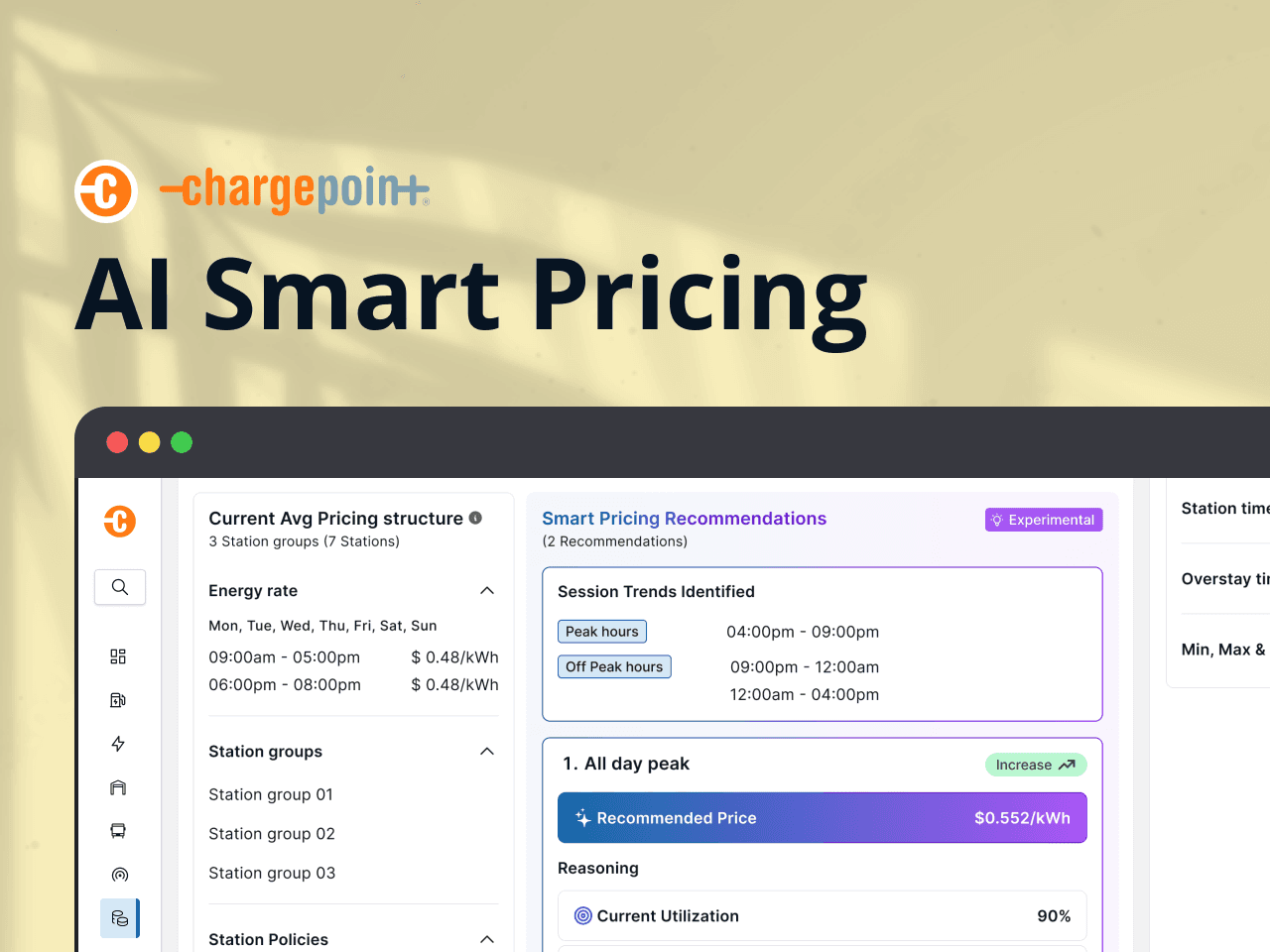
Enable Electron sellers to maximise revenue by AI-driven pricing engine to improve station pricing changes
💪🏻 This was the project that I (Akash Bulbule) and my fellow PM ( Monika) were responsible during our Journey in ChargePoint, Aimed to increase station owners revenue
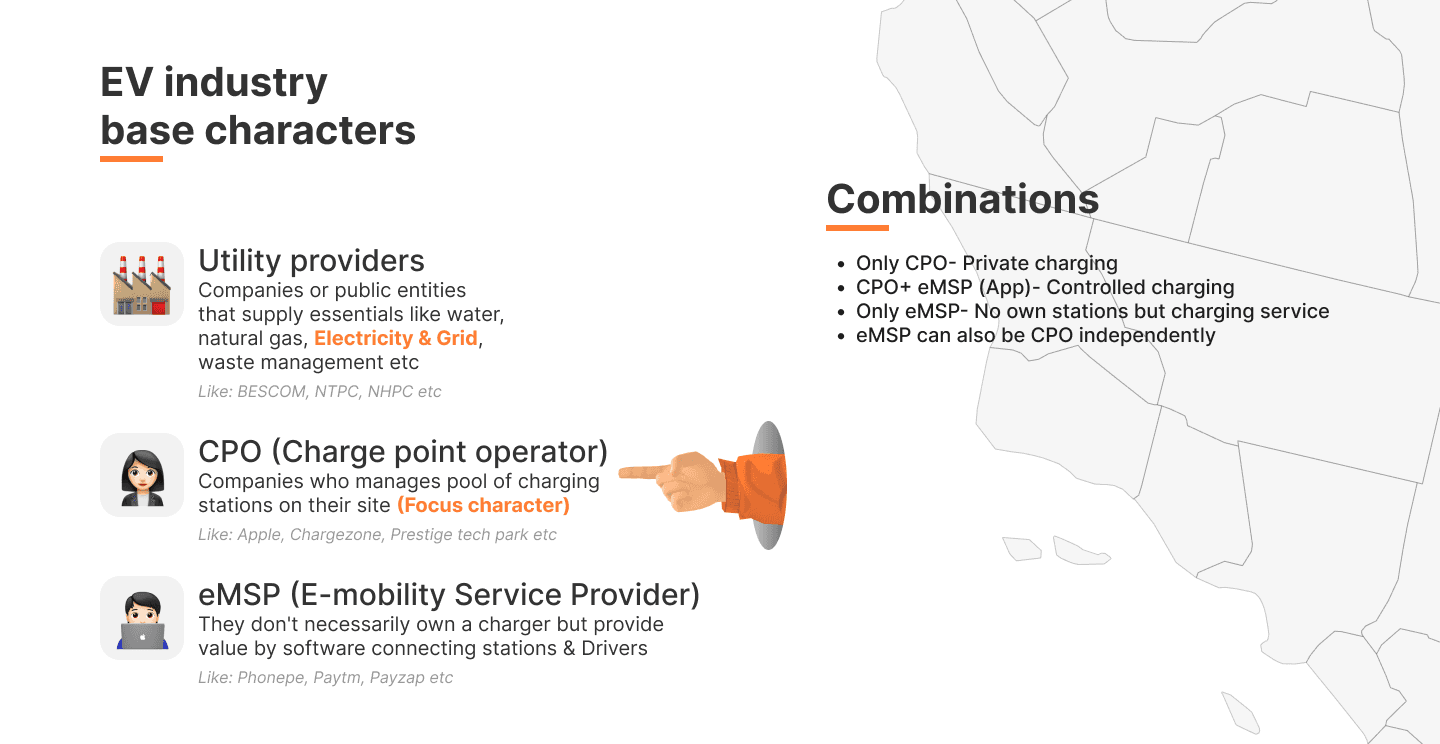
EV Industry context
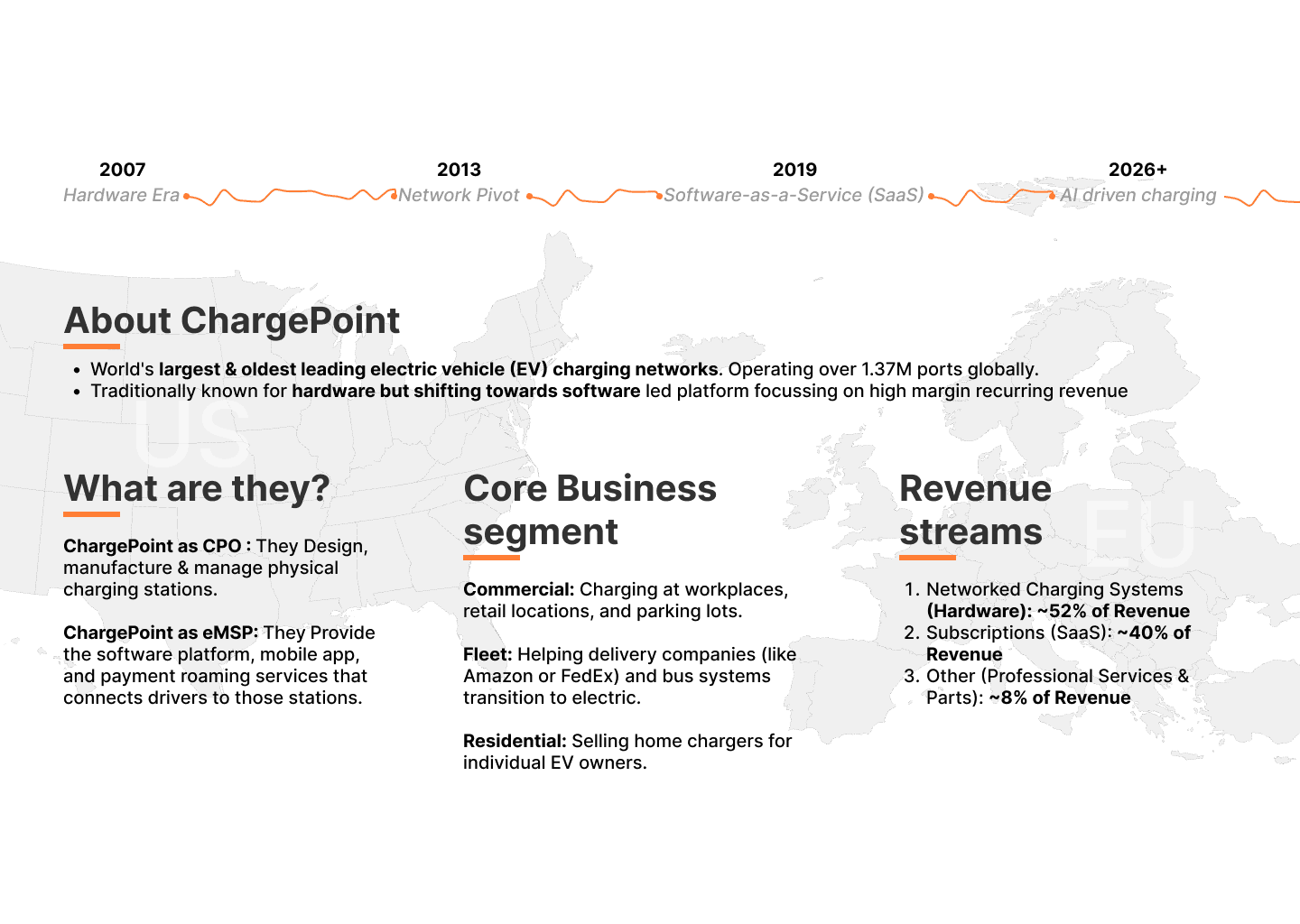
About ChargePoint
Why this project?
It solves a High-Cognitive Load problem (Complexity → Clarity)
Demonstrates AI as a Utility, not just a prototype
Connects Design to Business Levers (EBITDA)- Design moving Business needle
Project Content:
Context on EV industry (ChargePoint)
Problem / Data insights / Pod structure
Defining scope for project
Competitors & Research
Approach & Collaboration
Solution screens
Conclusion
Team Structure
Product lead: Monika (Sharfuz)
Data & AI lead: Ravi, Federica
Engineering lead: Sunny
UX lead: Akash B
Problem Statement🕵🏻♂️
Majority of EV charging stations are underperforming financially and are not profitable for station owners, which creates problem for future infrastructure investment from
Why?
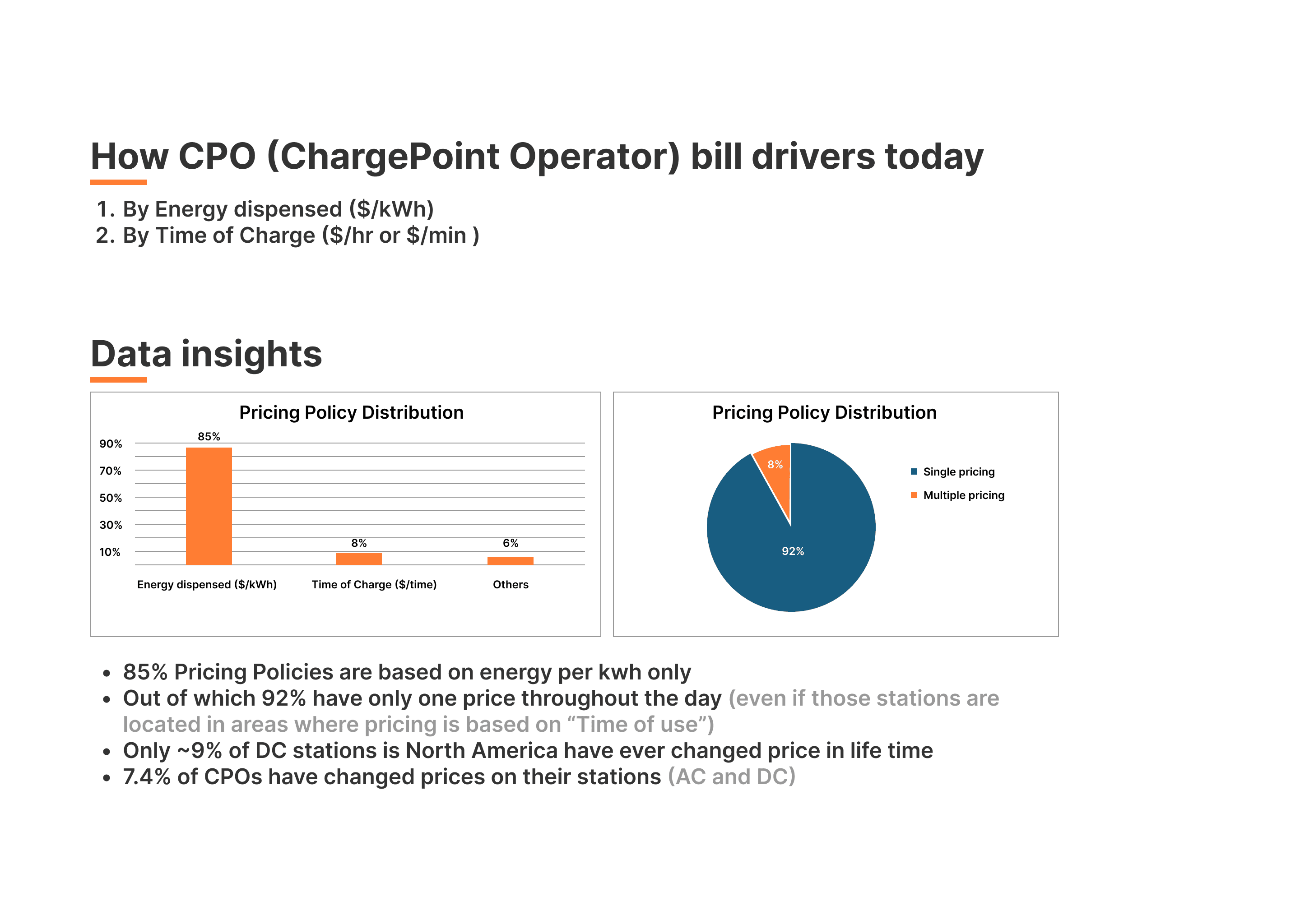
Coz Many major EV charging networks currently Use manual static pricing or a one-size-fits-all approach based on average state energy costs and basic competitive prices.
Problems in detailSet pricing are only banked on few inputs (Demand trends, Cost variability, and Optimal revenue opportunities)
Most public Sites sit under-utilised at slow hours, get slammed at peak hours, and pay punishing demand charges
Station Hosts are not as savvy or do not want to constantly monitor & updating charging prices based on competitors
Hosts fear what if drivers don’t show up if price increased
Data Insights
Type of station owners
Persona Type | Description | Company name | Reference in India | Charging Context | Primary Goals | Charger Type | Pricing Sensitivity |
|---|---|---|---|---|---|---|---|
Fleets “Keep vehicles charged” |
| Gillig, UPS (EU) | KSRTC Electric Bus depot, Uber depot | Vehicles have dedicated place (Depot) or daily charging |
| Both AC and DC stations | 🟢 Low |
Amenities Extender “Bring them in” |
| Startbucks, Local restro, Big box stores | Metro, Dmart, CCD, MCD etc |
|
| Mostly AC chargers | 🟢 Low |
Benefits Extender “Keep employees happy” |
| Google, Apple or Meta | Prestige tech park, Google, Microsoft |
|
| Mostly AC chargers | 🟡 Medium |
Electron Seller (aka CPO) “Every kWh counts” |
| BP pluse, Tesla, Love’s, Superchargers, Walmart fuelling stations | Tata Power EZ Charge, Jio-bp, and ChargeZone |
|
| Mostly DC fast chargers | 🔴 High Core to business (OUR FOCUS AREA) |
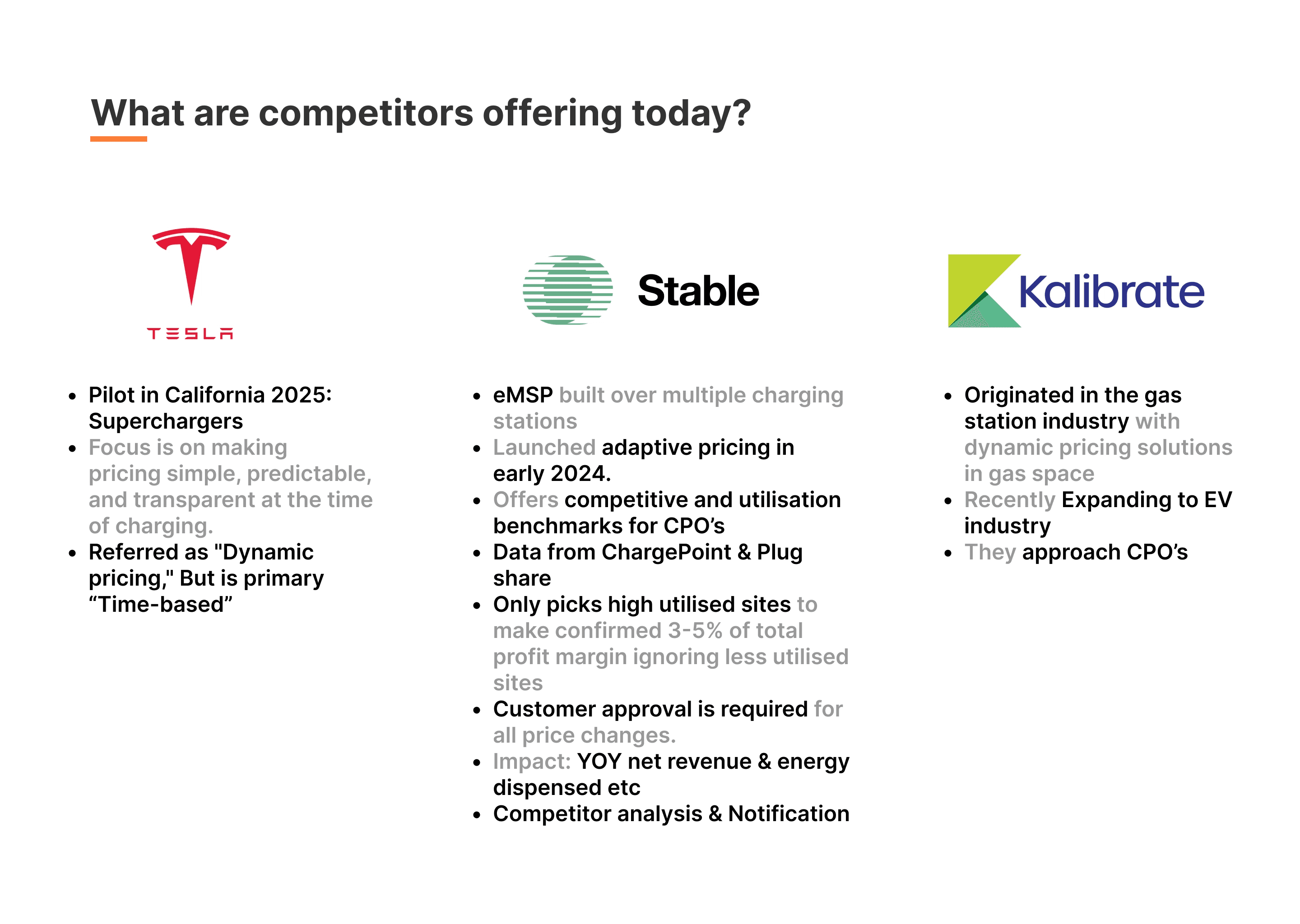
Competitors study
Our goal
Enable Electron sellers to maximise revenue by AI-driven pricing recommendation engine to improve pricing changes
How are we doing it?
Introducing Smart pricing AI engine in our Existing Pricing Flows
What is Smart pricing AI engine
AI model helping CPO’s move beyond static pricing for our EV charging stations.
In stead of "Set it and forget" price, this engine provides Dynamic recommendations that adapt to real-world conditions, aiming to Maximise revenue while remaining competitive and fair to our customers.
♵ My role as Product Designer
Collaboration: Worked at the intersection of Product, Engineering, and Data Science to define core workflows.
User Research: Facilitated PM interviews to identify revenue-generation pain points for owners.
AI-Driven Ideation: Developed rapid concepts for quick validation of the AI pricing recommendation engine.
Validation: Created interactive prototypes for stakeholder syncs and conducted rigorous user testing to ensure design efficacy.

Let's relook on problems
Problems
EV charging stations are not profitable coz they use manual static pricing or a one-size-fits-all approach based on average state energy costs and basic competitive prices.
Problems in detail:
Set pricing are only banked on few inputs (Demand trends, Cost variability, and Optimal revenue opportunities)
Most public Sites sit under-utilised at slow hours, get slammed at peak hours, and pay punishing demand charges
Station Hosts are not as savvy or do not want to constantly monitor & updating charging prices based on competitors
Hosts fear what if drivers don’t show up if price increased
How solve it?
Build Data-driven recommendation engine for pricing.
Leverage AI/ML where feasible to adapt to real-world conditions
Optimise for:
Revenue maximisation for station hosts (CPOs).
While remaining Competitive in the market (Eliminating Monopoly)
Fairness for loyal customers/drivers (Trust)
- With Station Hosts: Dynamic pricing must be transparent, explainable, and customisable. Hosts should never feel coerced or out of control.
- With Drivers: Drivers should understand when and why prices change. We will use consistent pricing explanations to ensure perceived fairness.
- With Our Ecosystem: We will never expose or use one host’s pricing to influence another host's pricing. Data privacy and competitive integrity are paramount.
Defined Metric Goals
Core metric: Site Revenue (Target = >5% lift) (Pure profit)
Counter metric: Site Utilisation (Target = >25%) (How many hours in a day is my station in use)
Factors Driving Pricing
Factors | As a ChargePoint Owner, I want to.. | So that.. |
Revenue info | Understand Cost & Revenue & # of sessions I make from charging at an overall org level at any point of time | I ensure optimal business outcomes for my EV charging business |
Utilisation | Know Utilisation pattern on site level | I know
|
Utilisation | I would like to have a discounted price in my most idle time to drive more traffic to my sites | I can increase earning more revenue at my slowest time |
Utilisation | I would like to increase my charging price when I am experience high queues | I can balance queues and driver wait time |
Configuration | Get recommendations to change my pricing based on events around my site
| I can increase my revenue in this competitive neighbourhood https://www.caiso.com/todays-outlook/demand#section-current (Fetching details from Open API’s) |
Energy Cost & Demand charge | Have my CMS intelligently set a price that based on demand charge and energy cost | I can offset peak hours and reduce energy cost |
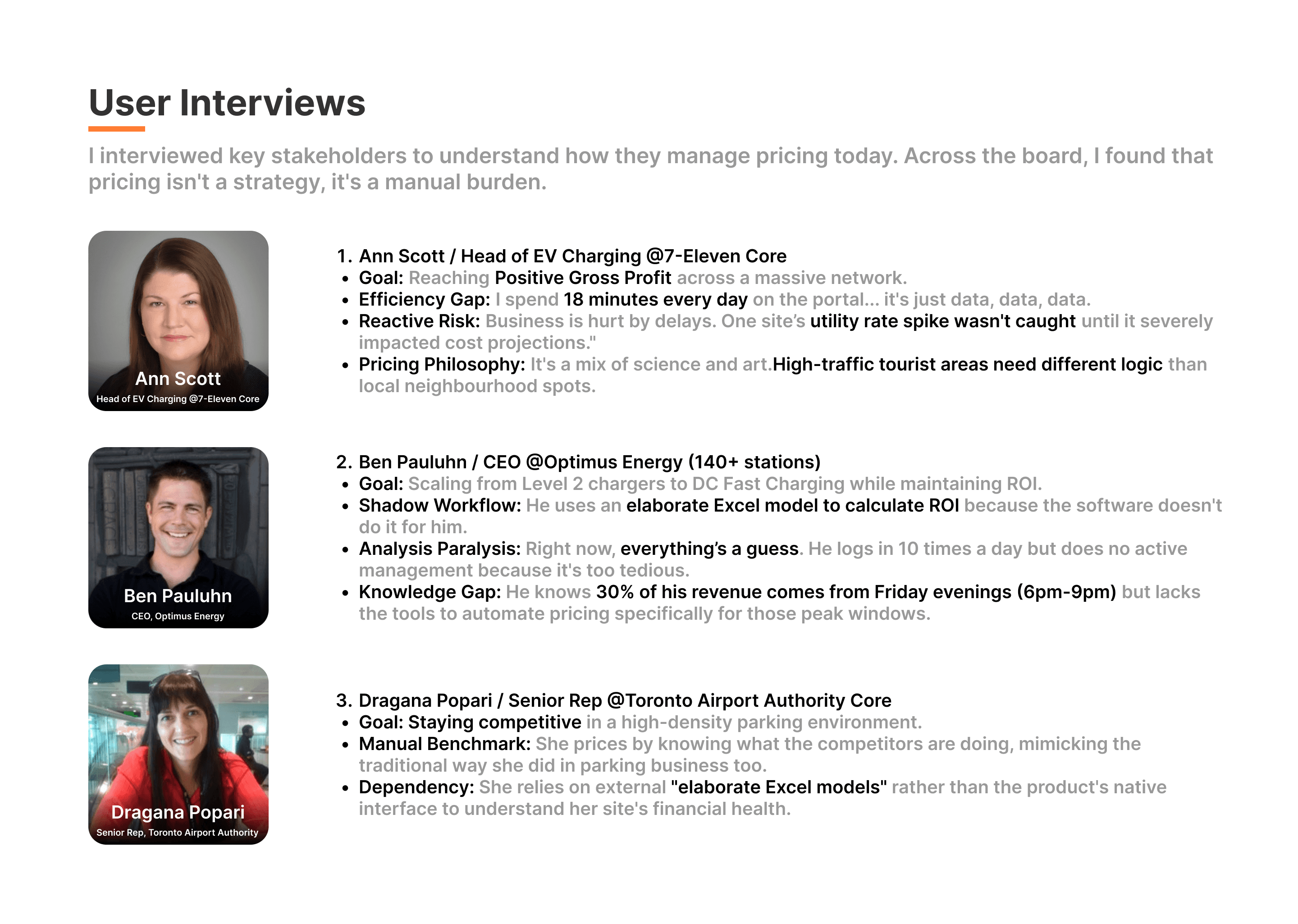
User story based on Interviews conducted
Theme/topic | As a ChargePoint Owner, I want to.. | So that.. | MVP Priority (MoSCoW) | Priority for user |
|---|---|---|---|---|
Insights/ KPI | have org level & site level insights on cost, revenue & Session level informations | I ensure optimal business outcomes for my EV charging business | Must have | P0 |
Insights/ KPI | see forecast of revenue generated based on potential pricing changes made on each sites | I can make data-driven decisions before applying them longterm settings | Could have | P0 |
Risk control | have guardrails for myself to play within so that I don’t make huge changes | I can control risks while experimenting with adaptive pricing | Need to have | P0 |
Experimentation | experiment with multiple pricing changes at specific sites | I can learn which strategies generate the most revenue over time. | Could have | P2 |
Update pricing | have alerts when a pricing rule negatively impacts revenue or sessions | I can act quickly to adjust to minimise losses | Could have | P2 |
Logs | view a history of pricing changes made at sites | I can revisit past adjustments, evaluate their results, or roll back if needed. | Could have | P2 |
Pricing schedule | want to schedule pricing changes in advance | I can align with peak hours, weekends, or events without any manual action from my side | Won’t have | P3 |
Automation | have configuration to choose balance between manual and automated pricing | I can decide how much my oversight is required for pricing changes | Could have | P3 |
Segment revenue | segmented data revenue performance by driver groups (e.g., my drivers vs. guests) | I can optimise pricing for different user types | Could have | P3 |
Solution 🌊
Hybrid Engine
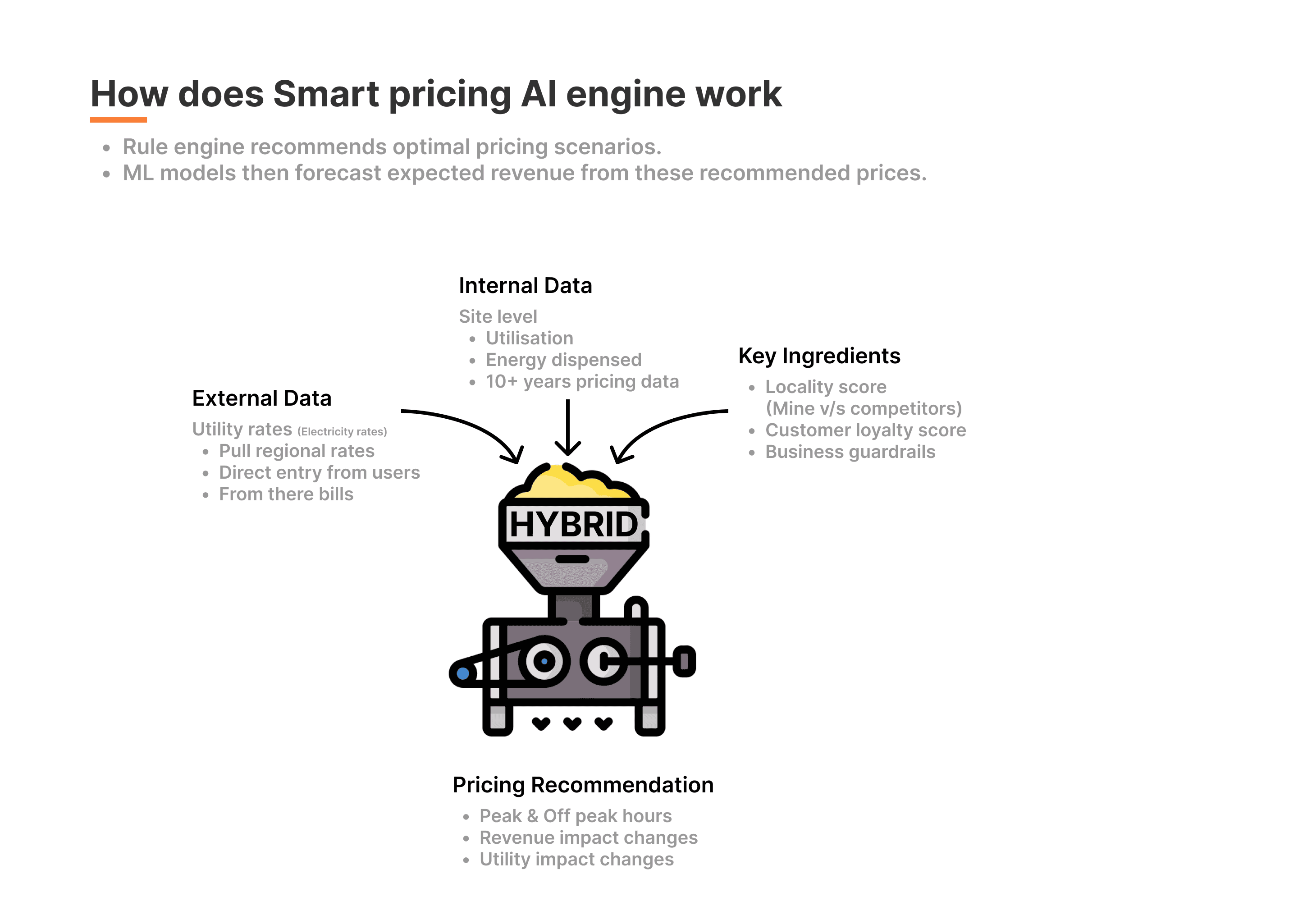
Smart pricing would be a hybrid engine which combines rule-based components with machine learning (ML) models to forecast utilisation based on historical and contextual data.
Rule engine recommends optimal pricing scenarios.
ML models then forecast expected revenue from these recommended prices.
External (Electricity cost)
Option 1-Direct text Input of utility rate manually through a form
Option 2- Pre-filled Estimation: Pull regional rates via OpenEI API
Option 3 - Upload a PDF/CSV of the bill to identity Utility provider & Plans
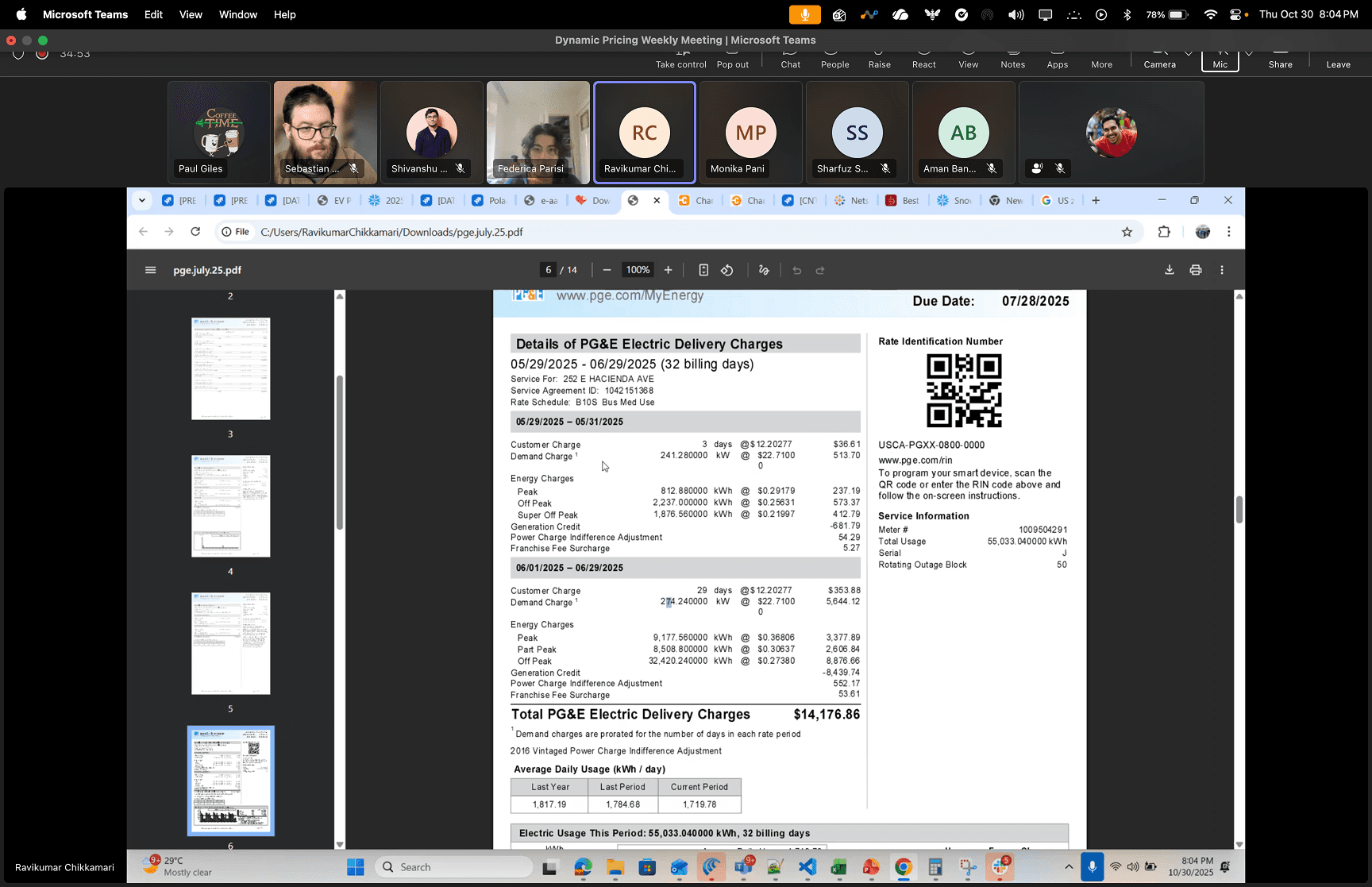
Internal Data inputs (Site level)
Utilisation (sessions/time of day, occupancy)
Energy dispensed (kWh/session, peak kW)
Pricing history & previous experiments
Internal Data inputs (Site level)
Historical transaction data (10+ years available) - CP & Roaming
Key Inputs to the Engine by Data team
Location Quality (Location Score):
A critical factor influencing driver choice alongside price and charging speed.
Stations near attractive amenities (restaurants, cafes, shops) have higher value.
Location score calculation:
Uses Google Places API data of businesses around the station.
Classifies businesses by category and incorporates their Google ratings.
Accounts for proximity (distance) to the station from amenities
A generative weighting model combines these factors to produce a numeric location score.
The location score serves as an important input feature in the pricing and utilization forecasting models to better tailor recommendations based on site attractiveness and competitive landscape.
Key Ingredients: What Data We Use
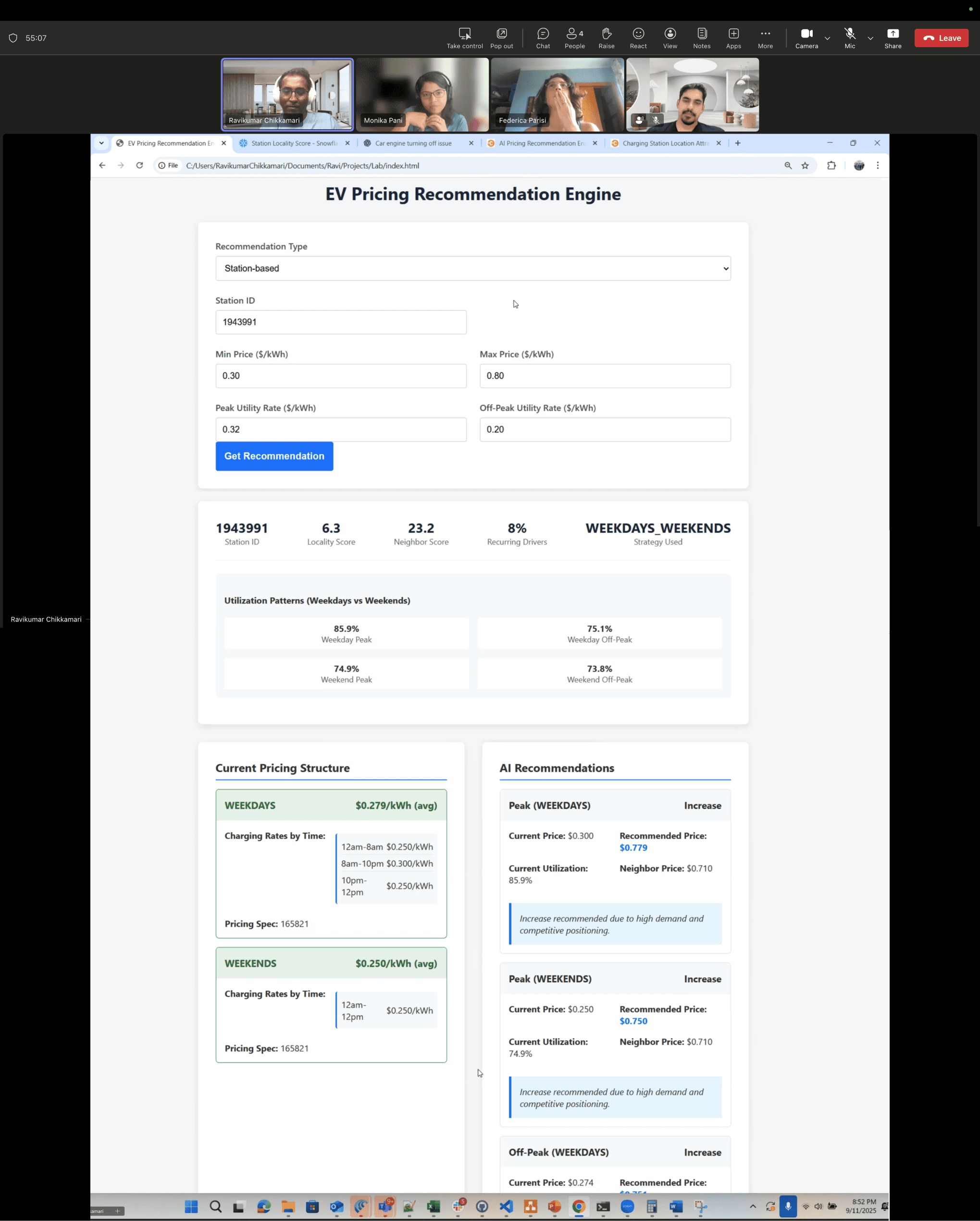
The engine makes its decisions by analysing data points providing a unique insight into a station's performance and market position.
Data Category | Key Metrics | Business Question It Answers |
|---|---|---|
Station Performance | Current Utilisation, Current Price | How busy is the station right now? How are we priced today? |
Competitor Landscape | Neighbour Prices, Neighbour Locality Score | What are our competitors charging? Are their locations better or worse than ours? |
Location Quality | Station Locality Score | How good is our station's location in absolute terms (e.g., near highways, restaurants)? |
Customer Loyalty | Recurring Driver Ratio | Do we have a base of loyal, repeat customers at this station? |
Business Rules (Guardrails) | Utility Cost, Min/Max Price | What is our base cost for electricity? What are the absolute price boundaries we must operate within? |
Data Team Prototype:
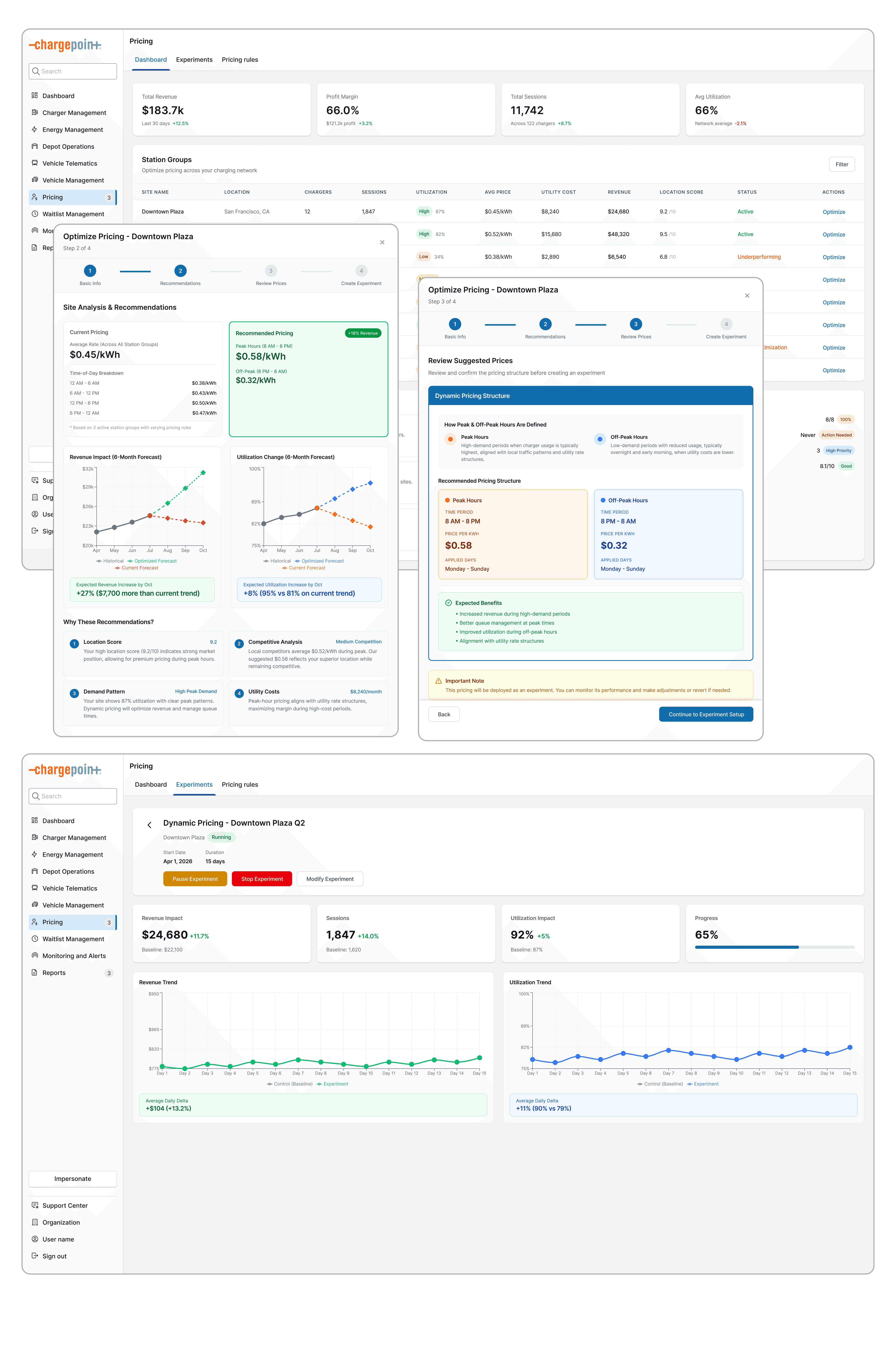
Figma Make Prototype:
Problems v/s Solution
Problem (Manual static pricing) | Solution (AI recommended pricing) |
|---|---|
Make pricing decision based on only few input | Intelligent Dashboard automatically provides real-time market data, enabling informed decisions with minimal manual input |
Sites sit under-utilised at slow hours, get slammed at peak hours | Implementing variable pricing to incentivise off-peak usage and maximise revenue during high-demand windows. |
Station Hosts are not as savvy, Don’t want to to constantly monitor | Dynamic dashboard manages complex pricing logic on behalf of the host, removing the need for 24/7 oversight. |
Fear what if drivers don’t show up if price increased | Risk-Mitigated Experimentation to run time-bound experiments with a fail-safe option to revert instantly. |
Outcome ⚡️⚡️
Successfully validated the impact of the AI Pricing Engine through direct engagement with 3 key customers with 7% revenue increase in 3 weeks timeframe
Summary & Strategic Pivot
Collaboration
My collaboration with the Product Management team continued till March 2026, during which I spearheaded the early-stage ideation, core feature definition, and the foundational workflow architecture.
Organisational Restructuring,
In late March 2026, the organisation underwent a major restructuring that led to a shift in product priorities.
Validation
Despite the project being placed on hold, we successfully validated the impact of the AI Pricing Engine through direct engagement with 3 key customers via detailed calls and data analysis.
Technical Challenges
The pivot was further influenced by dependencies on a new data architecture.
The AI recommendation engine required precise "site definitions" to function. However, the manual migration of users from the legacy system to the new architecture took longer than anticipated. This underscored the importance of data readiness in AI-driven design.
Future plan
The qualitative feedback from 3 customers confirmed that our design direction was sound, even as the implementation was rescheduled for future quarters.
Conclusion
While the company later shifted its strategic focus, this case study serves as a definitive record of the vision, solutions, and design systems I established during this phase.
It captures a robust design framework built to solve complex pricing and editing challenges in a competitive market.